

Permanent residence is the goal of many people already in Canada: it offers stability, broader rights and a step toward citizenship. But there is not just one route; there are several, and choosing the one that fits your profile makes all the difference. Here is an overview of the main pathways to Canadian permanent residence.
Express Entry
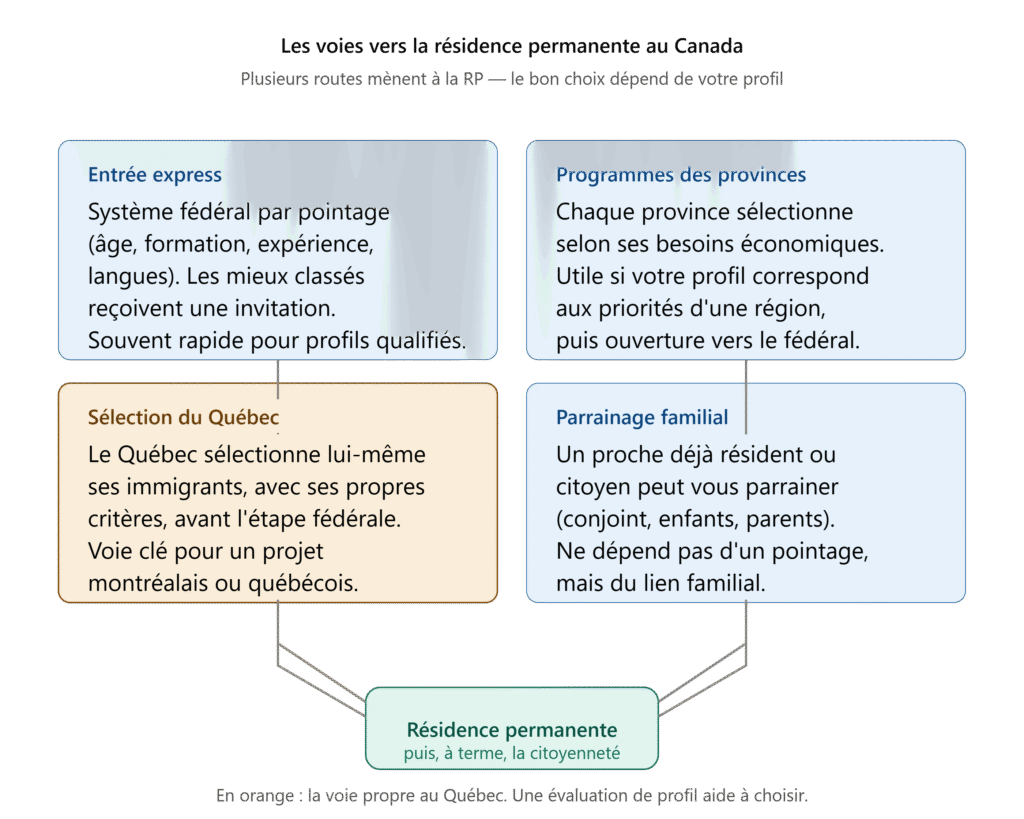
This is the best-known federal system. It manages several programs for skilled workers and works on points: your profile (age, education, experience, languages) is assessed and ranked. The top-ranked candidates receive an invitation to apply for permanent residence. It is often a fast track for skilled profiles.
Provincial programs
Each Canadian province has its own programs to attract the immigrants it needs (the Provincial Nominee Programs). A province can select you based on its economic priorities, which then opens the way to federal permanent residence. It is a valuable option if your profile matches the needs of a specific region.
Québec is different
Québec is the exception: it selects its own permanent immigrants, with its own programs and criteria. Someone who wants to settle in Québec generally goes through Québec selection before the federal stage. If your plans are in Montréal or Québec, understanding this two-step process is essential.
Family sponsorship
If you have a relative who is already a permanent resident or Canadian citizen, family sponsorship is a pathway to permanent residence in its own right, for spouses, children and in some cases parents and grandparents. It does not depend on points, but on the family relationship and its authenticity.
Canadian experience, an asset
Work or study experience already gained in Canada considerably strengthens several applications. It can improve your score, make you eligible for specific programs and show your integration. If you are already in Canada, it is an asset to make the most of.
Why your profile matters
Your age, education, experience, French or English skills and ties to Canada affect your eligibility and your chances. The same person may be eligible for several pathways, or for only one. A profile assessment identifies the most promising one, instead of spreading your efforts too thin.
Plan ahead and prepare
Permanent residence is often prepared well in advance: improving your language skills, gaining relevant experience, building a strong and complete file. The more you plan ahead, the more options you open up. Professional support helps you build a strategy suited to your situation.
Frequently asked questions
Do I need to be in Canada already to apply for permanent residence?
Not necessarily. Several pathways are open from abroad. That said, Canadian experience can be a major asset in many programs.
What is the difference between Express Entry and the provincial programs?
Express Entry is a federal system that ranks candidates by points. Provincial programs let a province select you based on its needs. The two can sometimes be combined.
Does Québec work like the rest of Canada?
No. Québec selects its own permanent immigrants, with its own criteria, before the federal stage. If your plans are in Québec, the process is different.
How long does a permanent residence application take?
Timelines vary a lot depending on the pathway chosen and your situation. An assessment gives realistic benchmarks.
Aiming for permanent residence in Canada? Our regulated professionals assess your profile and work out the best pathway with you. Book a consultation.

Un commentaire
Entrée express 2026 : emplois bien payés et Québec | PSK
July 29, 2026[…] comparer les voies possibles, lisez Devenir résident permanent au Canada : quelles sont les voies possibles ? ou consultez notre page résidence […]